Over the past few years, I have given my writing students a topic that asked who has changed their lives and whose lives they have changed in some way. It is often a subject that we think requires some great act or one that results in some momentous change. This is seldom the case.
My local newspaper had such a story which needs to be shared. Although I wrote the topic prior to this, the story illustrates what I had in mind.
The Oregonian (Portland, Oregon), November 22, 2009, Section O, page 2. “The legacy of the sandwich man” by Margie Boule.
I paraphrase this powerful piece without violating the privacy of the family involved.
A middle-aged man (I’ll call him Sam.) died suddenly, and the family published his obituary. Another man happened to see the photo and recognized the deceased. He visited the chapel where the viewing was held, but entered when the family had left. As this man appeared to be homeless, the lady (I’ll call her Ellen.) overseeing the visitation followed the man into the chapel fearing he would steal something. When Ellen asked if she could help the man, the homeless gentleman turned, and she could see tears in his eyes as he asked if this was truly the sandwich man.
The homeless man told Ellen of standing outside a building Sam passed daily. Although the man asked for money, at some point Sam decided to offer him a sandwich instead. A few times a week Sam would walk by, handing the homeless man the sandwich and never preaching to him about his situation. The man told Ellen that he shared the sandwich with others.
The funeral was held and hundreds of people attended, giving testimony of Sam’s other good deeds of helping the elderly, loaning money, supporting co-workers, etc. His family had no idea these acts of kindness had occurred.
The homeless many did not attend the funeral, but his story haunted Ellen and the stories of Sam’s kindness at the funeral made her wish she had known him. A week later, Ellen bought an extra sandwich and headed to the building where the homeless man was stationed. She handed him the sandwich; he smiled and said thank you. She continued this kindness until her company moved her to another suburb.
She started telling Sam’s story to her family and friends. She urged them to pass out sandwiches and many do. One of her friends has a bag of socks in her car and gives them out. Ellen has given her umbrella to a mother and child walking in the rain. She has purchased extra fast food to share with those more in need.
Ellen stated that Sam has changed her, and she now looks for ways to help others. The legacy of the Sandwich Man lives on in Ellen and her friends.
In this New Year, you can be the Sandwich Man. I challenge you to do acts of kindness every day and not to judge those people in need. Do not just say thank you or open a door; stretch yourself to do better than that. Make a list of what you can do; add to the list often; check off what you are doing. As you practice more random acts of kindness, more ideas will come to mind for your list.
To start your ideas, try these:
1. Carry protein bars in your car or your purse and hand them out to people on the road or sidewalk who need help.
2. Most cities have a location where you can purchase food certificates for the homeless. Buy those and pass those out. Be sure that you are in the area where the restaurant is as most homeless have difficulty getting around.
3. For the holidays and winter, purchase hats, scarves, gloves, and coats of all sizes for children. These can be dropped off at various shelters or schools.
4. In August gather school supplies you find on sale at various stories. Donate them to your local school. They will use them for those who cannot afford the items.
5. Take your old clothing to a Women’s shelter for the women and their children.
6. Take your used blankets and pillows to shelters.
7. Volunteer at a soup kitchen.
8. Help an elderly neighbor with cooking, cleaning, or doing errands.
9. Take food regularly to your local food bank.
10. If you are behind a person in the grocery line who is carefully counting their pennies or returning an item, let them know it is their lucky day and you are giving your change to help or buying the item for them.
11. Greet everyone on the street even if they do not return the gesture. Be sincere and ask how they are or wish them a good day. SMILE
12. Carry items in your car that you no longer really need. Everyone has more coats or gloves than we really need. Did you make cookies…hand out bags of them. Share what you have; hand them out to those who need them. You are better off than half of the population!
So how does this fit writing your childhood memories and family stories?
Think back on who gave you a little boost when you may have needed it. Maybe it was only verbal encouragement or they let you off the hook in a situation. Write about the people who changed your life, even in small ways. Write about how you have helped others in the past and now that you will continue the legacy of the Sandwich Man.
BUT more importantly, for this New Year…
As we age we either get sweeter or become grouchier. Which way are you leaning?
Vow to make the future better for everyone. Give of yourself so that you can receive; help those less off than you; practice random acts of kindness. In doing all this your days will be happy. You never know how much you touch another person and what a difference you make in their lives. Live as if there is nothing more important….because there isn’t!
May the New Year bring kindness and generosity to every heart. May it start with each of us!
Enjoy,
Emily
1 Jan 2010
Showing posts with label writing. Show all posts
Showing posts with label writing. Show all posts
Friday, January 1, 2010


Sunday, March 22, 2009
Making History by Kim Pearson
Making History: How to remember, record, interpret, and share the events of your life by Kim Pearson, Primary Sources Books, an imprint of Wyatt-MacKenzie, Issaquah, WA (www.primary-sources.com). ISBN: 978-1-032279-75-7. Copyright 2007. $24.95.
I do not usually review books, but when Kim sent me a copy, when several from my writing classes were interested in it, and as her idea of writing is similar to mine, I decided to mention it in my blog.
Many books have been written on the topic of writing one’s memoir. Formerly, there were the books for grandparents which asked basic questions about their lives, then came the books with the one-line topics. The latest generation of memoir writing books encompasses the reasons for writing, various topics, and suggested leads for those topics. Ms. Pearson’s book falls within the latter.
The book begins with excerpts from her writing class and from her own experiences. Although the book may start out a bit slow for some of us who have been involved in teaching such classes, there are many interesting stories which could give the reader ideas and activate the reader’s memories.
Making History is divided into sections: Why Tell Your Stories?, How to Tell Your Stories, and How Your Stories Fit into History with several chapters for each. She explains why she wrote the book and offers her sources (mostly Web sources) and some suggested reading.
Most of us understand that writing is therapeutic, although many genealogists wish to embellish their research by going beyond the dates and places of their ancestors. Many of us write to record those family stories and childhood memories for the future generations. Ms. Pearson gives ideas on how to deal with too much information as all of us have too little time to write all we really know about our lives and those of our ancestors.
From that point, Ms. Pearson divides her book into various sections (Economics & Politics, The Social Fabric, Wars & the International Scene, Technology & Science, Crime & Disaster, Arts & Entertainment, Lifestyle Activities, and The Weird, Trivial & Hard-to-Classify) and offers a detailed timeline for each period. Timelines start in 1930 and most end in 1989 with a few ending earlier. However, the best part of her book ends each of those chapters with ideas on which people can write. Usually there are about a dozen paragraphs for each chapter like the following.
“Scan the events timelines. What sparks a memory? Is there an event listed that makes you think, ‘oh yea, I remember that’? If so, write about this event. How did you learn about it? Di you talk about it? With whom? Were you inspired to do something because of this event? Did this event change your life in any way? Change your thinking?” (p. 119)
All though the timelines are extensive, they are not, of course, all encompassing. Many of these events were probably overlooked in most of our lives, but one never knows what statement will trigger a memory. You can supplement these timelines by using the Internet, if needed.
I suggest using this book as a workbook; that is, one needs to mark it up, underlining and starring important topics and ideas as the book is read. Use post-it notes so you can return to relevant topics and suggestions.
I am pleased to see this quality of book for writing one’s memories, especially as I have used similar techniques in teaching students and know them to work. I have applied the same method of including detailed prompts in my own publication (See the icon on this blog at the right.) and would encourage any of you not to purchase any book on writing prompts unless there is more detail for each topic than just a line or two.
Emily Aulicino
© Mar 2009
I do not usually review books, but when Kim sent me a copy, when several from my writing classes were interested in it, and as her idea of writing is similar to mine, I decided to mention it in my blog.
Many books have been written on the topic of writing one’s memoir. Formerly, there were the books for grandparents which asked basic questions about their lives, then came the books with the one-line topics. The latest generation of memoir writing books encompasses the reasons for writing, various topics, and suggested leads for those topics. Ms. Pearson’s book falls within the latter.
The book begins with excerpts from her writing class and from her own experiences. Although the book may start out a bit slow for some of us who have been involved in teaching such classes, there are many interesting stories which could give the reader ideas and activate the reader’s memories.
Making History is divided into sections: Why Tell Your Stories?, How to Tell Your Stories, and How Your Stories Fit into History with several chapters for each. She explains why she wrote the book and offers her sources (mostly Web sources) and some suggested reading.
Most of us understand that writing is therapeutic, although many genealogists wish to embellish their research by going beyond the dates and places of their ancestors. Many of us write to record those family stories and childhood memories for the future generations. Ms. Pearson gives ideas on how to deal with too much information as all of us have too little time to write all we really know about our lives and those of our ancestors.
From that point, Ms. Pearson divides her book into various sections (Economics & Politics, The Social Fabric, Wars & the International Scene, Technology & Science, Crime & Disaster, Arts & Entertainment, Lifestyle Activities, and The Weird, Trivial & Hard-to-Classify) and offers a detailed timeline for each period. Timelines start in 1930 and most end in 1989 with a few ending earlier. However, the best part of her book ends each of those chapters with ideas on which people can write. Usually there are about a dozen paragraphs for each chapter like the following.
“Scan the events timelines. What sparks a memory? Is there an event listed that makes you think, ‘oh yea, I remember that’? If so, write about this event. How did you learn about it? Di you talk about it? With whom? Were you inspired to do something because of this event? Did this event change your life in any way? Change your thinking?” (p. 119)
All though the timelines are extensive, they are not, of course, all encompassing. Many of these events were probably overlooked in most of our lives, but one never knows what statement will trigger a memory. You can supplement these timelines by using the Internet, if needed.
I suggest using this book as a workbook; that is, one needs to mark it up, underlining and starring important topics and ideas as the book is read. Use post-it notes so you can return to relevant topics and suggestions.
I am pleased to see this quality of book for writing one’s memories, especially as I have used similar techniques in teaching students and know them to work. I have applied the same method of including detailed prompts in my own publication (See the icon on this blog at the right.) and would encourage any of you not to purchase any book on writing prompts unless there is more detail for each topic than just a line or two.
Emily Aulicino
© Mar 2009
Sunday, February 22, 2009
Memories from a Photo
“Memoing” My Memories Topic 21:
Memories from a Photo
If you have not worked on your Timeline lately or cannot recall what else to add, try going through your old photos and jotting down events that happened around them. Hopefully, you have already written the names, locations, and dates on EVERY one of them! Your descendants would greatly appreciate that. If you are like me, you may do it in spurts! It took two broken ankles to get many of them done! I am not hoping to finish the job in the same way, however!
Often looking at the old photos, sharing them with your family, children or grandchildren, you start to recall why that photo was taken, the details of that trip, the wonderful times with those friends….
Choose a photo from your life or one of a family member and write about the circumstances around that photo; your thoughts and memories at that time. Take the time to reflect on how life was then, and possibly how it has changed. What were the people in the photo like; what are your fondest memories of them…?
Remember to include your photo with your computer or paper files.
Reminder: What other photos could you use to help add to your Timeline or stories?
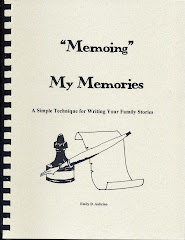
Suggestion: This and the previous ideas are from my booklet "Memoing" My Memories which contains 130 similar prompts on a huge variety of subjects. This booklet is worth the value as it contains many ideas within each prompt. The sprial bound booklet is available by emailing me at: aulicino@hevanet.com
Memories from a Photo
If you have not worked on your Timeline lately or cannot recall what else to add, try going through your old photos and jotting down events that happened around them. Hopefully, you have already written the names, locations, and dates on EVERY one of them! Your descendants would greatly appreciate that. If you are like me, you may do it in spurts! It took two broken ankles to get many of them done! I am not hoping to finish the job in the same way, however!
Often looking at the old photos, sharing them with your family, children or grandchildren, you start to recall why that photo was taken, the details of that trip, the wonderful times with those friends….
Choose a photo from your life or one of a family member and write about the circumstances around that photo; your thoughts and memories at that time. Take the time to reflect on how life was then, and possibly how it has changed. What were the people in the photo like; what are your fondest memories of them…?
Remember to include your photo with your computer or paper files.
Reminder: What other photos could you use to help add to your Timeline or stories?
Suggestion: This and the previous ideas are from my booklet "Memoing" My Memories which contains 130 similar prompts on a huge variety of subjects. This booklet is worth the value as it contains many ideas within each prompt. The sprial bound booklet is available by emailing me at: aulicino@hevanet.com
Saturday, February 21, 2009
Kreative Blogger Award

Earline Hines Bradt at AncestralNotes has presented me with this award.
What a wonderful surprise. I'm very surprised and deeply humbled.
Thank you Earline!
Here are the instructions:
1. Copy the award to your site.
2. Link to the person from whom you received the award.
3. Nominate 7 other bloggers.
4. Link to those sites on your blog.
5. Leave a message on the blogs you nominate.
Although this was difficult to decide, my list of nominees are:
1. The Photo Detective
2. Dear Myrtle
3. The Geneaholic
4. The Chart Chick
5. Forensic Genealogy Blog
7. The Practical Archivist
6. The Genetic Genealogist
Tuesday, February 17, 2009
The Neighborhood
Below is another excerpt from my booklet. As you can see, those I am posting here are not in order listed in the booklet, but are some random topics to give you the range of ideas and approaches to writing your childhood memories and family stories. This particular topic developed from a teaching strategy and was written in 2003. It is a wonderful subject for many, many stories, and some of my writing students have used it as an underlying theme for their entire memoirs. Even if you lived in several neighborhoods, this can section your life in to various units and allow you to write many memories within the time span, giving the reader an entire picture of your life.
"Memoing" My Memories Topic 8:
The Neighborhood
As we have discussed your childhood home/homes in Topic 4, let us focus on the neighborhood in general and the activities and the events surrounding it. No doubt this could result in countless stories, so we’ll start with a great brainstorming technique to give you the bases for future writings, as well.
If you lived in more than one home, pick one for now, but try this with all of them, if you can. A neighborhood could just be the block on which you lived or the few houses surrounding your rural home.
First, think back to what your neighborhood was like. Was it rural, urban, or suburban? Did you live in a large or small town, in the middle of the city or on the perimeter?
Who were the neighbors? Can you remember their names? Which houses were theirs?
Was there a unique member of your neighborhood...a kind person who asked you to do errands and tipped you enough for a candy bar or ice cream...a grouchy person whose yard often harbored your baseball or balsa wood airplane...the person whom no one knew well…? Was there a bully on the block? (Even if it was YOU!)
What games did you play in the street or yards with neighbor kids? What games differed from the summer through the winter? Where did you play—a vacant lot, the end of the street, a particular yard? Did everyone get along?
After thinking about these things, draw a map of your childhood street. Add some features unique to each house and the names of the people in the houses. Now choose an event centered on this area and write. Be certain to jot down other ideas on which to write later. There is no doubt many great stories to tell….
©Aulicino, Sept 2003
"Memoing" My Memories Topic 8:
The Neighborhood
As we have discussed your childhood home/homes in Topic 4, let us focus on the neighborhood in general and the activities and the events surrounding it. No doubt this could result in countless stories, so we’ll start with a great brainstorming technique to give you the bases for future writings, as well.
If you lived in more than one home, pick one for now, but try this with all of them, if you can. A neighborhood could just be the block on which you lived or the few houses surrounding your rural home.
First, think back to what your neighborhood was like. Was it rural, urban, or suburban? Did you live in a large or small town, in the middle of the city or on the perimeter?
Who were the neighbors? Can you remember their names? Which houses were theirs?
Was there a unique member of your neighborhood...a kind person who asked you to do errands and tipped you enough for a candy bar or ice cream...a grouchy person whose yard often harbored your baseball or balsa wood airplane...the person whom no one knew well…? Was there a bully on the block? (Even if it was YOU!)
What games did you play in the street or yards with neighbor kids? What games differed from the summer through the winter? Where did you play—a vacant lot, the end of the street, a particular yard? Did everyone get along?
After thinking about these things, draw a map of your childhood street. Add some features unique to each house and the names of the people in the houses. Now choose an event centered on this area and write. Be certain to jot down other ideas on which to write later. There is no doubt many great stories to tell….
©Aulicino, Sept 2003
Friday, February 6, 2009
Writing Your First Memory
Up to now, I have covered various elements of the writing process and will continue do so, but mixed with topics which may be of interest to those who are writing their childhood memories and family stories. The topics either appear in my current booklet or will appear in my second volume. They will be selected at random and will not be in any chonrological order. Most people accomplish more by writing what motivates them at the time rather than starting at the beginning of their lives and continuing to the present.
These topics are based on the idea that you are keeping a Timeline of your life and make reference to it periodically. There will be other reminders, as well.
I will not be posting a vast amount of my booklet, but only samples. Therefore, if you are interested in purchasing my booklet, please email me at: aulicino@hevanet.com
“Memoing” My Memories Topic 1:
Writing Your First Memory
A bit of a double entendre here! Yes, this is your first writing piece and it will (for now) be your very first memory. Who knows how much more you will recall as we push forward!
Think back to your earliest days. You must honestly choose your earliest memory. YOUR memory…not an event your parents described to you or you recall from an old photo...unless you REALLY REMEMBER being there. In your mind, you have to seek the memory of actually being present. This may only be a fleeting memory…not long, but you can write about the circumstances around it.
Don't be alarmed that your first conscious memory may be later than others. I know some VERY intelligent people whose memories go back to age five or six only. There are a few who can remember back to age three, but, seemingly, not the majority.
You will get a chance to write about earlier events that your parents, friends or relatives have helped you remember all these years, but for now...the oldest memory YOU can recall.
Return to your Timeline and write this memory in the appropriate year. You may have to base the year on the location, who was present with you, what you wore, the season, the approximate age of the people around you, etc. Get as detailed as you can, but if you haven't the time, make notes in your file first...add as you recall the incident.
©aulicino, 6 Feb 2009
These topics are based on the idea that you are keeping a Timeline of your life and make reference to it periodically. There will be other reminders, as well.
I will not be posting a vast amount of my booklet, but only samples. Therefore, if you are interested in purchasing my booklet, please email me at: aulicino@hevanet.com
“Memoing” My Memories Topic 1:
Writing Your First Memory
A bit of a double entendre here! Yes, this is your first writing piece and it will (for now) be your very first memory. Who knows how much more you will recall as we push forward!
Think back to your earliest days. You must honestly choose your earliest memory. YOUR memory…not an event your parents described to you or you recall from an old photo...unless you REALLY REMEMBER being there. In your mind, you have to seek the memory of actually being present. This may only be a fleeting memory…not long, but you can write about the circumstances around it.
Don't be alarmed that your first conscious memory may be later than others. I know some VERY intelligent people whose memories go back to age five or six only. There are a few who can remember back to age three, but, seemingly, not the majority.
You will get a chance to write about earlier events that your parents, friends or relatives have helped you remember all these years, but for now...the oldest memory YOU can recall.
Return to your Timeline and write this memory in the appropriate year. You may have to base the year on the location, who was present with you, what you wore, the season, the approximate age of the people around you, etc. Get as detailed as you can, but if you haven't the time, make notes in your file first...add as you recall the incident.
©aulicino, 6 Feb 2009
Friday, January 23, 2009
Incorporate Word and Sentence Variety
Edit Is a Four Letter Word, con't
The letter I is for:
Incorporate word and sentence variety
“Variety is the spice of life” someone once said. Redundancy is quite the opposite, and if our lives held nothing new and exciting, they would be very boring. This is so very true of writing. We must strive for variety and not accept redundancy. Shake up your writing! Bring it to life with spice!
Word Variety:
To incorporate word variety, we must understand redundancy. Redundancy includes repetitiveness as well as excess, but it is useful for emphasis, for remembering something difficult, and for establishing a mood. Often we use more words than needed to express an idea, or we repeat ourselves unintentionally. Redundancy in oral presentations and in writing, unless needed for emphasis, is not a positive trait for an author. Using redundant phrases and words shows thinking errors, and does not ease the flow of your writing.
There are several types of redundancy, and the following situations often harbor unnecessary words that can be easily corrected.
1. Repetition of
....a. Pronouns (I, he, they, etc.)
....b. Boring verbs (is, was, had, got, etc.)
....c. Adjectives and qualifiers (really, so, a lot, fantastic, very, etc.)
2. Two words which indicate the same meaning (Tautology)*
3. More words than are needed (Pleonasm)
4. Phrases when a word would convey the same meaning
*The terminology is unimportant, but expanding your vocabulary is always important.
1. Repetition of Pronouns, boring verbs, and adjectives and qualifiers
We use the same vocabulary constantly. Often we write as we speak. It is much easier to say he did this or that; we went here or there. We are concentrating on getting ideas across to someone, but are not concerned with how we state those thoughts. We have all been taught not to say I over and over, so we do try to avoid that, but what about the other common pronouns? We don’t realize how often we use the same simple verbs or constantly say a lot, awesome, fantastic, etc. Do you every use a thesaurus?
....a. Pronouns
The easiest way to recognize our redundant vocabulary use is to circle all the pronouns in your story, and omit what you can by using names or reworking your sentences.
Original:
After Rob left the house, he stopped by Rachel’s to pick her up for the show before she left on her own.
Revised:
Rob left the house in time to grab Rachel so they could ride together to the show.
Four pronouns were narrowed to one.
....b. Boring Verbs
(See the previous post: Edit by Rewording)
Word variety includes using exciting verbs rather than boring ones. Check your sentences for overused verbs that are forms of to be and exchange them for verbs which show action. Limit your use of common verbs such as had, have, get, take, etc. If necessary keep a list of the verbs you tend to use and some more exciting replacements for them.
To find these boring verbs in your writing, take a pen which differs in color from that you used to write and circle all the boring verbs. Then with another pen circle the non-boring verbs that you used more than two or three times. Now replace these verbs in a variety of ways.
You may substitute one verb for a better one.
Original:
Sam ran down the hill and came home before the storm.
Revised:
Racing down the hill, Sam arrived before the storm.
You may restructure or combine your sentence to eliminate a verb.
Original:
Orin was late for school, and he was panting when he reached the room.
Revised:
Panting, Orin entered the room just after the tardy bell.
....c. Adjectives and qualifiers
The over use of words which describe (adjectives) or limit a noun (qualifiers) are no different than any other redundant word: limit them; remove them; change them.
Original:
We really had a fantastic time with a lot of our friends. We always enjoy their company, and we always exchange a lot of gifts. What a fantastic night!
Revised:
We had a wonderful time with our friends, enjoying their company and exchanging gifts. What a fantastic night!
In the revision, no word is repeated…except a.
2. Tautology, the error of saying essentially the same thing again in the same sentence
Many of these phrases are so blatantly used in our culture that we do not realize the inaccuracy.
Advanced forward
Future outlook
False facts
Few in number
Usual custom
He wrote his own autobiography.
Let us glance briefly at the facts.
The reason was because….5.
3. Pleonasm, having extra words in a sentence than can be deleted without changing the meaning or structure of the sentence
Original:
Deep puddles of water wrestled against….
Revised:
Deep puddles wrestled against….
4. Phrases replaced by one word6.
The reason is because……….because
Based on the fact that………..because
In regard to…………………..about
Despite the fact that………….although
At this time…………………..now
In the very near future……….soon
Actual experience……………experience
Cancel out……………………cancel
Sentence Variety:
Sentence variety means every story needs to have sentences that vary in length and in structure. Reading short, choppy sentences does not allow good flow of ideas and events. Reading lengthy sentences gives the piece a pretentious air, makes it difficult to wade through the extraneous words. Either situation will not encourage your reader to continue through the story. A variety of short, simple sentences along with compound and complex sentences provides the diversity to keep your reader interested.
Short sentences are used to emphasis a point and to give impact to an idea. Compound sentences link together closely related ideas. Complex sentences show relationships between more important ideas over supporting ideas. Careful use and placement of the various types of sentences adds power to your writing.
Simple: He left yesterday.
Compound: He left yesterday, and he took nothing with him.
Complex: After leaving yesterday and taking nothing with him, I knew it was over.
Add details to improve the overall structure and to provide an opportunity for more exciting verbs. Do not have most of your sentences with the subject-verb pattern. Use phrases to alter the structure.
Original:
Sarah wasn’t happy at school because she had few friends.
Revised:
Having few friends reinforced Sarah’s dislike for school.
Sentence Phrases
Using several phrases in your sentence allows you to alter the sentence structure. The easiest way is to develop phrases for your sentence that tells where, why, when, and how. Those phrases can then be move to various locations to determine which way sounds best.
Example:
Matt ran. (kernal sentence)
Matt ran home. (Tells where Matt ran.)
Matt ran home to arrive before the letter carrier. (Tells why Matt ran home.)
Matt ran home yesterday. (Tells when Matt ran home.)
Matt ran home quickly. (Tells how Matt ran.)
Sometimes you may wish to use several of these phrases, but seldom do you want to use them all. Often after you construct the phrases, you may wish to change the verb and alter some of the phrases.
There are three locations for any phrase: the beginning, the middle, the end. Some sound better in one place than the other. For this reason, practice moving them from place to place to determine what sounds best. Also, commas are used after a phrase that begins a sentence and sometimes if a phrase is in the middle of the sentence.
Examples:
Yesterday, Matt raced home quickly to arrive before the letter carrier.
Matt raced home quickly, yesterday, to arrive before the letter carrier.
Quickly, Matt raced home yesterday to arrive before the letter carrier.
To arrive before the letter carrier, Matt raced home quickly.
To arrive before the letter carrier, Matt raced home quickly, yesterday.
As you can see, the yesterday in the fifth sentence is not smooth. Some are better than others, but this gives you some variety.
Using a gerund for sentence variety
A gerund is a verb with an ing ending. For this sentence structure, your subject must be doing two activities at the same time. Note the comma before the gerund.
Original:
Jason picked at his food.
Jason fed the dog when no one was watching.
Revised:
Jason picked at his food, feeding the dog when no one was watching.
Paragraph variety:
Just like a single word or a short sentence gives emphasis to an idea, so does a short paragraph. Each of these stands out among the average size, but they all lose their emphasis if overused. Make them count where needed.
Remember: Overuse of any word or structure devalues its impact.
Next, the letter T in that Four Letter Word Edit.
T is for Take Time to Read Your Story Aloud.
Source (adapted from):
Cheney, Theodore A. Rees. Getting the Words Right: How to Revice, Edit & Rewrite, Writer’s Digest Books, Cincinnati, OH, 1987.
6. ibid., p. 64-66.
©Aulicino 5 Dec 2008
The letter I is for:
Incorporate word and sentence variety
“Variety is the spice of life” someone once said. Redundancy is quite the opposite, and if our lives held nothing new and exciting, they would be very boring. This is so very true of writing. We must strive for variety and not accept redundancy. Shake up your writing! Bring it to life with spice!
Word Variety:
To incorporate word variety, we must understand redundancy. Redundancy includes repetitiveness as well as excess, but it is useful for emphasis, for remembering something difficult, and for establishing a mood. Often we use more words than needed to express an idea, or we repeat ourselves unintentionally. Redundancy in oral presentations and in writing, unless needed for emphasis, is not a positive trait for an author. Using redundant phrases and words shows thinking errors, and does not ease the flow of your writing.
There are several types of redundancy, and the following situations often harbor unnecessary words that can be easily corrected.
1. Repetition of
....a. Pronouns (I, he, they, etc.)
....b. Boring verbs (is, was, had, got, etc.)
....c. Adjectives and qualifiers (really, so, a lot, fantastic, very, etc.)
2. Two words which indicate the same meaning (Tautology)*
3. More words than are needed (Pleonasm)
4. Phrases when a word would convey the same meaning
*The terminology is unimportant, but expanding your vocabulary is always important.
1. Repetition of Pronouns, boring verbs, and adjectives and qualifiers
We use the same vocabulary constantly. Often we write as we speak. It is much easier to say he did this or that; we went here or there. We are concentrating on getting ideas across to someone, but are not concerned with how we state those thoughts. We have all been taught not to say I over and over, so we do try to avoid that, but what about the other common pronouns? We don’t realize how often we use the same simple verbs or constantly say a lot, awesome, fantastic, etc. Do you every use a thesaurus?
....a. Pronouns
The easiest way to recognize our redundant vocabulary use is to circle all the pronouns in your story, and omit what you can by using names or reworking your sentences.
Original:
After Rob left the house, he stopped by Rachel’s to pick her up for the show before she left on her own.
Revised:
Rob left the house in time to grab Rachel so they could ride together to the show.
Four pronouns were narrowed to one.
....b. Boring Verbs
(See the previous post: Edit by Rewording)
Word variety includes using exciting verbs rather than boring ones. Check your sentences for overused verbs that are forms of to be and exchange them for verbs which show action. Limit your use of common verbs such as had, have, get, take, etc. If necessary keep a list of the verbs you tend to use and some more exciting replacements for them.
To find these boring verbs in your writing, take a pen which differs in color from that you used to write and circle all the boring verbs. Then with another pen circle the non-boring verbs that you used more than two or three times. Now replace these verbs in a variety of ways.
You may substitute one verb for a better one.
Original:
Sam ran down the hill and came home before the storm.
Revised:
Racing down the hill, Sam arrived before the storm.
You may restructure or combine your sentence to eliminate a verb.
Original:
Orin was late for school, and he was panting when he reached the room.
Revised:
Panting, Orin entered the room just after the tardy bell.
....c. Adjectives and qualifiers
The over use of words which describe (adjectives) or limit a noun (qualifiers) are no different than any other redundant word: limit them; remove them; change them.
Original:
We really had a fantastic time with a lot of our friends. We always enjoy their company, and we always exchange a lot of gifts. What a fantastic night!
Revised:
We had a wonderful time with our friends, enjoying their company and exchanging gifts. What a fantastic night!
In the revision, no word is repeated…except a.
2. Tautology, the error of saying essentially the same thing again in the same sentence
Many of these phrases are so blatantly used in our culture that we do not realize the inaccuracy.
Advanced forward
Future outlook
False facts
Few in number
Usual custom
He wrote his own autobiography.
Let us glance briefly at the facts.
The reason was because….5.
3. Pleonasm, having extra words in a sentence than can be deleted without changing the meaning or structure of the sentence
Original:
Deep puddles of water wrestled against….
Revised:
Deep puddles wrestled against….
4. Phrases replaced by one word6.
The reason is because……….because
Based on the fact that………..because
In regard to…………………..about
Despite the fact that………….although
At this time…………………..now
In the very near future……….soon
Actual experience……………experience
Cancel out……………………cancel
Sentence Variety:
Sentence variety means every story needs to have sentences that vary in length and in structure. Reading short, choppy sentences does not allow good flow of ideas and events. Reading lengthy sentences gives the piece a pretentious air, makes it difficult to wade through the extraneous words. Either situation will not encourage your reader to continue through the story. A variety of short, simple sentences along with compound and complex sentences provides the diversity to keep your reader interested.
Short sentences are used to emphasis a point and to give impact to an idea. Compound sentences link together closely related ideas. Complex sentences show relationships between more important ideas over supporting ideas. Careful use and placement of the various types of sentences adds power to your writing.
Simple: He left yesterday.
Compound: He left yesterday, and he took nothing with him.
Complex: After leaving yesterday and taking nothing with him, I knew it was over.
Add details to improve the overall structure and to provide an opportunity for more exciting verbs. Do not have most of your sentences with the subject-verb pattern. Use phrases to alter the structure.
Original:
Sarah wasn’t happy at school because she had few friends.
Revised:
Having few friends reinforced Sarah’s dislike for school.
Sentence Phrases
Using several phrases in your sentence allows you to alter the sentence structure. The easiest way is to develop phrases for your sentence that tells where, why, when, and how. Those phrases can then be move to various locations to determine which way sounds best.
Example:
Matt ran. (kernal sentence)
Matt ran home. (Tells where Matt ran.)
Matt ran home to arrive before the letter carrier. (Tells why Matt ran home.)
Matt ran home yesterday. (Tells when Matt ran home.)
Matt ran home quickly. (Tells how Matt ran.)
Sometimes you may wish to use several of these phrases, but seldom do you want to use them all. Often after you construct the phrases, you may wish to change the verb and alter some of the phrases.
There are three locations for any phrase: the beginning, the middle, the end. Some sound better in one place than the other. For this reason, practice moving them from place to place to determine what sounds best. Also, commas are used after a phrase that begins a sentence and sometimes if a phrase is in the middle of the sentence.
Examples:
Yesterday, Matt raced home quickly to arrive before the letter carrier.
Matt raced home quickly, yesterday, to arrive before the letter carrier.
Quickly, Matt raced home yesterday to arrive before the letter carrier.
To arrive before the letter carrier, Matt raced home quickly.
To arrive before the letter carrier, Matt raced home quickly, yesterday.
As you can see, the yesterday in the fifth sentence is not smooth. Some are better than others, but this gives you some variety.
Using a gerund for sentence variety
A gerund is a verb with an ing ending. For this sentence structure, your subject must be doing two activities at the same time. Note the comma before the gerund.
Original:
Jason picked at his food.
Jason fed the dog when no one was watching.
Revised:
Jason picked at his food, feeding the dog when no one was watching.
Paragraph variety:
Just like a single word or a short sentence gives emphasis to an idea, so does a short paragraph. Each of these stands out among the average size, but they all lose their emphasis if overused. Make them count where needed.
Remember: Overuse of any word or structure devalues its impact.
Next, the letter T in that Four Letter Word Edit.
T is for Take Time to Read Your Story Aloud.
Source (adapted from):
Cheney, Theodore A. Rees. Getting the Words Right: How to Revice, Edit & Rewrite, Writer’s Digest Books, Cincinnati, OH, 1987.
6. ibid., p. 64-66.
©Aulicino 5 Dec 2008
Wednesday, December 31, 2008
Draft as Many Versions as Needed for Clarity, Part 2
Edit Is a Four Letter Word, con't
The letter D is for:
Draft as many versions as needed for clarity
Part 2: Edit by Rearranging
Unity
Often a story must be rearranged in order to create a harmony, a unity within itself. Everything aspect must blend and every area must not go beyond the intended focus. This step in revising your draft looks at the unity of individual aspects of writing. Before you begin, you need to review the purpose and direction of your writing. What is your goal for this piece? What is the focus? What message are you trying to convey?
The following areas must agree; they must be consistent throughout your writing.
1. Subject matter – Did you stay on subject or go beyond it?
2. Scope – Have you omitted some areas of your topic or have you stayed within the guidelines of your focus? Working from an outline could help keep you organized.
3. Tone – Does your story have a mood, an attitude which is consistent throughout the piece? Can the reader determine easily that your story is serious, sad, humorous, etc.?
4. Style – Does your style shine? Does the style of writing remain the same voice to the end?
5. Point of View – Did you switch point of view?
6. Characterization – Did you develop believable characters with realistic actions?
7. Scene – Do you move your reader through various scenes with ease? Do your characters interact with the scenery as needed, and is that scenery developed?
8. Tense – Are the verbs in the same tense or if there’s a reason to have different tenses, have you kept them in proper sequence. That is, if a subordinate action happens before the main action, the subordinate action must be in the past tense.
9. Sentences and Paragraphs – Does each sentence deal with similar ideas? If the ideas are distinctively different the sentences are not unified. For a unified paragraph the sentences must be related to the paragraph’s topic and be in a coherent sequence.
Coherence
A coherent story is a combination of logic and form and deals with putting the various elements of your writing in good order. This includes the sequencing of words into sentences, sentences into paragraphs, paragraphs into chapters, etc.
The major methods for organizing are chronological, spatial, and from general to specific. In using chronological sequencing, decide whether your story is best told from past to the present, present to future, or present backward to the past? Or should you start in the middle, then go back and then forward? Descriptive passages are usually best suited for spatial logic. The author should move the reader’s eye in a logical sequence such as from left to right, up to down, etc. when describing a scene. When using general to specific organization or vice-versa maintain this order throughout the story. Choose the method that best fits your story and maintain its unity throughout.
All references need to be unambiguous for the writing to be coherent. You must not lose the reader through confusion. Be careful of sentences that begin with pronouns. Does the previous sentence clarify to whom or what the pronoun refers? Refrain from using multiple pronouns in a sentence as the reader may become confused as to who did what.
Be certain that phrases are in their correct places. Check any sentence with multiple pieces by moving the phrases around to make the meaning clear.
Original:
The keypunch operator incorrectly punched in a program, which created a power failure in the building where she worked for two days.
Revised:
…which created a power failure for two days in the building where she worked.2.
Smooth transitions between ideas in sentences as well as between paragraphs are important for clear understanding. When there are several ideas are of equal importance, the sentence needs a parallel structure.
Original:
She had never gone to a part alone, much less an event like this.
Revised:
She had never gone alone to a party much less to an event like this.
Original:
Readers appreciate your getting to the heart of a matter in a hurry, rather than being forced to red through paragraphs or pages to find it.
Revised:
Readers appreciate your getting to the heart of a matter in a hurry, rather than forcing them to read though…
Original:
We can attack at night or we can do it in the light.
Revised:
We can attack by night or by day.3.
When ideas are not of equal importance, the ideas must not be placed in a parallel form. Some ideas are subordinate to others, and the sentence must clearly indicate that for the reader. For these types of sentences it is best to use one of three logical orders.
1. Time – Lay out the events in the order they occurred.
2. Relationship – Show cause and effect as needed. Time order often reflects the relationship between events.
In the following example, the order of time is used. However, this sentence also shows the order of relationship…a cause and effect.
After the storm abated, I went below. Because the porthole had opened during the storm, damage to the crew’s quarters was severe.4.
3. Emphasis – Place the most important event first to emphasize its significance.
After the storm, I went down below. The crew’s quarters were severely damaged—the porthole had opened during the storm. This, after I had just conducted a storm rill in which Howard had been permanently assigned to dog down that particular porthole.
The above example does place the focus on the open porthole rather than on the storm. For this reason, the author must be wise in selecting the type of order that best fits the focus of the writing.
Smooth transitions
One of the easiest ways to have smooth transitions between sentences is to repeat a key word or a key thought from the previous sentence. Sometimes you may wish to use a synonym, but sometimes the same word works best.
Although there are some trite phrases commonly used for transitions between paragraphs, the same technique of repeating a word or phrase used with sentences can be used with paragraphs. Often the key word, phrase, or idea in the final sentence may be repeated or restructured to use in the first sentence of the next paragraph.
Another type of transition is the one between scenes. Often the author can move the reader from one scene to another with a few simple words.
Example:
Marge sat in the den at the computer, busily typing as the wind howled. Soon creaking sounds began to intensify. She ran to the windows to see what tree was soon to be history.
Next door, the McGill’s peered from their window, gasping in unison as a huge branch from the elm just missed their house.
As you can see the words next door moved the scene from one location to the next with ease.
Another method is to leave extra line of space between paragraphs indicating that extra time has passed and, therefore, a change of scene.
In some cases, the author may choose to use the last sentence of a paragraph to change the scene rather than the first sentence of the next paragraph. Sometimes, the author may only hint at a change of scene in the last sentence. This would be done to continue the rising flow of excitement.
Example:
Bent over the desk for hours, I had managed to block out the sound of the furnace starting and stopping and the creaks of the old house while trying to focus on my writing. I was under a deadline, and the pressure was mounting when…brrr-inggg! Dang, the phone!
I raced to the living room to quiet the monster, tripping on the kids' toys….
The phone ringing indicates an immediate change of scene, whether the phone is in the same room or another.
All parts of the story must be coherent, including the beginning, middle and end. Check your story to see if it flows well between these major elements. The plot is usually hinted at in the beginning and then is developed in the middle. Here the conflict becomes apparent to the point of crisis. The ending provides the resolution of the conflict and ties up any loose ends.
Remember: Although editing is a difficult and lengthy task, you will develop skills that will improve your writing in the initial stages so editing will become easier. There is much detail here, so take one step at a time. Your readers will love you for the improvements, and you will be proud of your work.
Next, the letter D (part 3 of 3) in that four letter word Edit.
D stands for: Draft as many versions as needed for clarity.
Part 3 covers Edit by Rewording
Source (adapted from):
Cheney, Theodore A. Rees. Getting the Words Right: How to Revice, Edit & Rewrite, Writer’s Digest Books, Cincinnati, OH, 1987.
2. Cheney, p. 59.
3. ibid., p. 64-66.
4. ibid., p. 69.
©Aulicino 5 Dec 2008
The letter D is for:
Draft as many versions as needed for clarity
Part 2: Edit by Rearranging
Unity
Often a story must be rearranged in order to create a harmony, a unity within itself. Everything aspect must blend and every area must not go beyond the intended focus. This step in revising your draft looks at the unity of individual aspects of writing. Before you begin, you need to review the purpose and direction of your writing. What is your goal for this piece? What is the focus? What message are you trying to convey?
The following areas must agree; they must be consistent throughout your writing.
1. Subject matter – Did you stay on subject or go beyond it?
2. Scope – Have you omitted some areas of your topic or have you stayed within the guidelines of your focus? Working from an outline could help keep you organized.
3. Tone – Does your story have a mood, an attitude which is consistent throughout the piece? Can the reader determine easily that your story is serious, sad, humorous, etc.?
4. Style – Does your style shine? Does the style of writing remain the same voice to the end?
5. Point of View – Did you switch point of view?
6. Characterization – Did you develop believable characters with realistic actions?
7. Scene – Do you move your reader through various scenes with ease? Do your characters interact with the scenery as needed, and is that scenery developed?
8. Tense – Are the verbs in the same tense or if there’s a reason to have different tenses, have you kept them in proper sequence. That is, if a subordinate action happens before the main action, the subordinate action must be in the past tense.
9. Sentences and Paragraphs – Does each sentence deal with similar ideas? If the ideas are distinctively different the sentences are not unified. For a unified paragraph the sentences must be related to the paragraph’s topic and be in a coherent sequence.
Coherence
A coherent story is a combination of logic and form and deals with putting the various elements of your writing in good order. This includes the sequencing of words into sentences, sentences into paragraphs, paragraphs into chapters, etc.
The major methods for organizing are chronological, spatial, and from general to specific. In using chronological sequencing, decide whether your story is best told from past to the present, present to future, or present backward to the past? Or should you start in the middle, then go back and then forward? Descriptive passages are usually best suited for spatial logic. The author should move the reader’s eye in a logical sequence such as from left to right, up to down, etc. when describing a scene. When using general to specific organization or vice-versa maintain this order throughout the story. Choose the method that best fits your story and maintain its unity throughout.
All references need to be unambiguous for the writing to be coherent. You must not lose the reader through confusion. Be careful of sentences that begin with pronouns. Does the previous sentence clarify to whom or what the pronoun refers? Refrain from using multiple pronouns in a sentence as the reader may become confused as to who did what.
Be certain that phrases are in their correct places. Check any sentence with multiple pieces by moving the phrases around to make the meaning clear.
Original:
The keypunch operator incorrectly punched in a program, which created a power failure in the building where she worked for two days.
Revised:
…which created a power failure for two days in the building where she worked.2.
Smooth transitions between ideas in sentences as well as between paragraphs are important for clear understanding. When there are several ideas are of equal importance, the sentence needs a parallel structure.
Original:
She had never gone to a part alone, much less an event like this.
Revised:
She had never gone alone to a party much less to an event like this.
Original:
Readers appreciate your getting to the heart of a matter in a hurry, rather than being forced to red through paragraphs or pages to find it.
Revised:
Readers appreciate your getting to the heart of a matter in a hurry, rather than forcing them to read though…
Original:
We can attack at night or we can do it in the light.
Revised:
We can attack by night or by day.3.
When ideas are not of equal importance, the ideas must not be placed in a parallel form. Some ideas are subordinate to others, and the sentence must clearly indicate that for the reader. For these types of sentences it is best to use one of three logical orders.
1. Time – Lay out the events in the order they occurred.
2. Relationship – Show cause and effect as needed. Time order often reflects the relationship between events.
In the following example, the order of time is used. However, this sentence also shows the order of relationship…a cause and effect.
After the storm abated, I went below. Because the porthole had opened during the storm, damage to the crew’s quarters was severe.4.
3. Emphasis – Place the most important event first to emphasize its significance.
After the storm, I went down below. The crew’s quarters were severely damaged—the porthole had opened during the storm. This, after I had just conducted a storm rill in which Howard had been permanently assigned to dog down that particular porthole.
The above example does place the focus on the open porthole rather than on the storm. For this reason, the author must be wise in selecting the type of order that best fits the focus of the writing.
Smooth transitions
One of the easiest ways to have smooth transitions between sentences is to repeat a key word or a key thought from the previous sentence. Sometimes you may wish to use a synonym, but sometimes the same word works best.
Although there are some trite phrases commonly used for transitions between paragraphs, the same technique of repeating a word or phrase used with sentences can be used with paragraphs. Often the key word, phrase, or idea in the final sentence may be repeated or restructured to use in the first sentence of the next paragraph.
Another type of transition is the one between scenes. Often the author can move the reader from one scene to another with a few simple words.
Example:
Marge sat in the den at the computer, busily typing as the wind howled. Soon creaking sounds began to intensify. She ran to the windows to see what tree was soon to be history.
Next door, the McGill’s peered from their window, gasping in unison as a huge branch from the elm just missed their house.
As you can see the words next door moved the scene from one location to the next with ease.
Another method is to leave extra line of space between paragraphs indicating that extra time has passed and, therefore, a change of scene.
In some cases, the author may choose to use the last sentence of a paragraph to change the scene rather than the first sentence of the next paragraph. Sometimes, the author may only hint at a change of scene in the last sentence. This would be done to continue the rising flow of excitement.
Example:
Bent over the desk for hours, I had managed to block out the sound of the furnace starting and stopping and the creaks of the old house while trying to focus on my writing. I was under a deadline, and the pressure was mounting when…brrr-inggg! Dang, the phone!
I raced to the living room to quiet the monster, tripping on the kids' toys….
The phone ringing indicates an immediate change of scene, whether the phone is in the same room or another.
All parts of the story must be coherent, including the beginning, middle and end. Check your story to see if it flows well between these major elements. The plot is usually hinted at in the beginning and then is developed in the middle. Here the conflict becomes apparent to the point of crisis. The ending provides the resolution of the conflict and ties up any loose ends.
Remember: Although editing is a difficult and lengthy task, you will develop skills that will improve your writing in the initial stages so editing will become easier. There is much detail here, so take one step at a time. Your readers will love you for the improvements, and you will be proud of your work.
Next, the letter D (part 3 of 3) in that four letter word Edit.
D stands for: Draft as many versions as needed for clarity.
Part 3 covers Edit by Rewording
Source (adapted from):
Cheney, Theodore A. Rees. Getting the Words Right: How to Revice, Edit & Rewrite, Writer’s Digest Books, Cincinnati, OH, 1987.
2. Cheney, p. 59.
3. ibid., p. 64-66.
4. ibid., p. 69.
©Aulicino 5 Dec 2008
Monday, December 22, 2008
Draft as Many Versions as Needed for Clarity, Part 1
Edit Is a Four Letter Word, con't
The letter D is for:
Draft as many versions as needed for clarity
Part 1: Edit by Reducing
Editing takes time as I have stated. Even if you choose to write only a couple of drafts and call the last one your final, it is wise to leave several days between each draft. This allows you to get a different perspective on your story. You get a fresh new look at it if you put it aside. This will help you find questionable areas and help you discover how they may be corrected.
The purpose in editing is to make your ideas clear to your reader. There are many methods to editing for clarity, so try one at a time. Remember, draft as many versions as needed for clarity. Do not mentally state you will do only two drafts before you ever begin, but leave that door open. In doing so, you will find the light at the end and be happier for it.
The following method of editing is only one way and will be presented here in three separate sections due to the length of information. The idea of editing is to first remove chunks of text that do not fit the story or chapter. Then to gradually fine tune each paragraph, each sentence, and then your words and phrases. By looking at the large picture first and narrowing your scope, you reduce your work. Remember, editing takes time, but you’ll love the finished product as will your readers.
The major steps for this section are as follows:
Part 1: Edit by Reducing
Part 2: Edit by Rearranging
Part 3: Edit by Rewording
Remember: You write for yourself; you edit for others.
Part 1: Edit by Reducing
Nonprofessional writers are excited to see so many words on a page; however, the professional is pleased to cut their writing into precise text. It is the quality of the words, not quantity that separates the novice from the pro.
When we write we tend to record everything we can recall on the subject or situation. Writing in this manner helps us remember better, and often we are either jotting facts in the margins or writing sentences out of order as more pops into our minds. This often leads to excessive information that hampers the flow of the story.
In your first revision, look for chunks of verbiage that are not needed. How do you find these chunks to remove? Ask yourself if these pieces actually move the story forward. It is very difficult for the novice to remove parts of the story, but save these chucks as they may be revived later for another story or included in this one after alterations.
After removing the larger chunks, focus on the remaining parts and rewrite to smooth any evidence of your splicing and dicing. The reader must not realize you have eliminated sections, but see only a smooth flow of ideas.
The following is an example of reduction:
Original:
The restaurant was set back from the road approximately 100 feet. There was parking on both sides of the restaurant and the area set aside for parking was separated by an area of well-kept grass.
Revised:
The restaurant was set back bout 100 feet, with parking on both sides of the well-kept lawn.1.
As you repair your writing, stitching the story together, you may notice other smaller reductions which are necessary. However, do not complete these reductions at this time. Flag them in some way and return to this job later. Think of this as cleaning out the attic. You can only throw away so much at a time and must stop for fear of tossing something you may later regret. Putting time between your reductions will give you a better perspective on what is really needed.
Once you are ready to continue reduction, look at individual words to see if a larger word is less precise than a more simple word. The goal is clarity and accuracy of meaning. Each word has a slightly different meaning and the writer needs to use the most precise word possible.
As we scrutinize our writing we will find unnecessary words and phrases. For example, instead of writing, “…was very comprehensive in nature,” drop the in nature. Those words do not alter the meaning.
Next, the letter D (part 2 of 3) in that four letter word Edit.
D stands for: Draft as many versions as needed for clarity.
Part 2 covers Edit by Rearranging
Source (adapted from):
Cheney, Theodore A. Rees. Getting the Words Right: How to Revice, Edit & Rewrite, Writer’s Digest Books, Cincinnati, OH, 1987.
1. Cheney, p. 33.
©Aulicino 5 Dec 2008
The letter D is for:
Draft as many versions as needed for clarity
Part 1: Edit by Reducing
Editing takes time as I have stated. Even if you choose to write only a couple of drafts and call the last one your final, it is wise to leave several days between each draft. This allows you to get a different perspective on your story. You get a fresh new look at it if you put it aside. This will help you find questionable areas and help you discover how they may be corrected.
The purpose in editing is to make your ideas clear to your reader. There are many methods to editing for clarity, so try one at a time. Remember, draft as many versions as needed for clarity. Do not mentally state you will do only two drafts before you ever begin, but leave that door open. In doing so, you will find the light at the end and be happier for it.
The following method of editing is only one way and will be presented here in three separate sections due to the length of information. The idea of editing is to first remove chunks of text that do not fit the story or chapter. Then to gradually fine tune each paragraph, each sentence, and then your words and phrases. By looking at the large picture first and narrowing your scope, you reduce your work. Remember, editing takes time, but you’ll love the finished product as will your readers.
The major steps for this section are as follows:
Part 1: Edit by Reducing
Part 2: Edit by Rearranging
Part 3: Edit by Rewording
Remember: You write for yourself; you edit for others.
Part 1: Edit by Reducing
Nonprofessional writers are excited to see so many words on a page; however, the professional is pleased to cut their writing into precise text. It is the quality of the words, not quantity that separates the novice from the pro.
When we write we tend to record everything we can recall on the subject or situation. Writing in this manner helps us remember better, and often we are either jotting facts in the margins or writing sentences out of order as more pops into our minds. This often leads to excessive information that hampers the flow of the story.
In your first revision, look for chunks of verbiage that are not needed. How do you find these chunks to remove? Ask yourself if these pieces actually move the story forward. It is very difficult for the novice to remove parts of the story, but save these chucks as they may be revived later for another story or included in this one after alterations.
After removing the larger chunks, focus on the remaining parts and rewrite to smooth any evidence of your splicing and dicing. The reader must not realize you have eliminated sections, but see only a smooth flow of ideas.
The following is an example of reduction:
Original:
The restaurant was set back from the road approximately 100 feet. There was parking on both sides of the restaurant and the area set aside for parking was separated by an area of well-kept grass.
Revised:
The restaurant was set back bout 100 feet, with parking on both sides of the well-kept lawn.1.
As you repair your writing, stitching the story together, you may notice other smaller reductions which are necessary. However, do not complete these reductions at this time. Flag them in some way and return to this job later. Think of this as cleaning out the attic. You can only throw away so much at a time and must stop for fear of tossing something you may later regret. Putting time between your reductions will give you a better perspective on what is really needed.
Once you are ready to continue reduction, look at individual words to see if a larger word is less precise than a more simple word. The goal is clarity and accuracy of meaning. Each word has a slightly different meaning and the writer needs to use the most precise word possible.
As we scrutinize our writing we will find unnecessary words and phrases. For example, instead of writing, “…was very comprehensive in nature,” drop the in nature. Those words do not alter the meaning.
Next, the letter D (part 2 of 3) in that four letter word Edit.
D stands for: Draft as many versions as needed for clarity.
Part 2 covers Edit by Rearranging
Source (adapted from):
Cheney, Theodore A. Rees. Getting the Words Right: How to Revice, Edit & Rewrite, Writer’s Digest Books, Cincinnati, OH, 1987.
1. Cheney, p. 33.
©Aulicino 5 Dec 2008
Thursday, December 18, 2008
Educate Yourself on Grammar and Punctuation Rules
Edit Is a Four Letter Word
The letter E is for: Educate yourself on grammar and punctuation rules
Volumes have been written on grammar and punctuation rules. Not only does our language constantly change, but the experts do not agree on some conventions. Different types of writing require different editing conventions. We write differently for newspapers than for books. Memoir writing is allowed more laterality than technical writing. Even publishing houses have their on editing standards.
For reasons of form and emphasis, some writers choose to break the rules. We all know that a sentence must have a subject and a verb, but for emphasis, sentence fragments are sometimes used or even one word. Paragraphs are to have a topic sentence and supporting details, but there are times when a writer uses only one sentence. In dialogue, bad grammar, and colloquial phrases are allowed. Informal writing allows contractions (I’ve, we’ll, isn’t), but technical writing does not.
For all these reasons, any writer may find it difficult to edit for grammar and punctuation.
The internet is a good reference, but use only websites which are authorities on the subject. Avoid the blogs as they allow readers to provide answers and whose authors often do not have the qualifications needed to fully understand the nuances. Editing for grammar and punctuation is not an easy task.
Reliable websites
The Perdue Online Writing Lab (OWL)
Covers the basics in an easy to understand manner and provides worksheets and answers.
http://owl.english.purdue.edu/
The Blue Book of Grammar and Punctuation
Rated number one by teachers. You can buy a book or use some online links, complete with interactive and graded quizzes.
http://www.grammarbook.com/
Guide to Grammar and Writing
Has an extensive index, provides quizzes and allows you to ask questions.
http://grammar.ccc.commnet.edu/grammar/
Next, the letter D in that four letter word Edit.
D stands for: Draft as many versions as needed for clarity.
©Aulicino 5 Dec 2008
The letter E is for: Educate yourself on grammar and punctuation rules
Volumes have been written on grammar and punctuation rules. Not only does our language constantly change, but the experts do not agree on some conventions. Different types of writing require different editing conventions. We write differently for newspapers than for books. Memoir writing is allowed more laterality than technical writing. Even publishing houses have their on editing standards.
For reasons of form and emphasis, some writers choose to break the rules. We all know that a sentence must have a subject and a verb, but for emphasis, sentence fragments are sometimes used or even one word. Paragraphs are to have a topic sentence and supporting details, but there are times when a writer uses only one sentence. In dialogue, bad grammar, and colloquial phrases are allowed. Informal writing allows contractions (I’ve, we’ll, isn’t), but technical writing does not.
For all these reasons, any writer may find it difficult to edit for grammar and punctuation.
The internet is a good reference, but use only websites which are authorities on the subject. Avoid the blogs as they allow readers to provide answers and whose authors often do not have the qualifications needed to fully understand the nuances. Editing for grammar and punctuation is not an easy task.
Reliable websites
The Perdue Online Writing Lab (OWL)
Covers the basics in an easy to understand manner and provides worksheets and answers.
http://owl.english.purdue.edu/
The Blue Book of Grammar and Punctuation
Rated number one by teachers. You can buy a book or use some online links, complete with interactive and graded quizzes.
http://www.grammarbook.com/
Guide to Grammar and Writing
Has an extensive index, provides quizzes and allows you to ask questions.
http://grammar.ccc.commnet.edu/grammar/
Next, the letter D in that four letter word Edit.
D stands for: Draft as many versions as needed for clarity.
©Aulicino 5 Dec 2008
Friday, December 12, 2008
Edit is a Four Letter Word
Yes, Edit—that four-letter-word which keeps many from writing and others with constant migraines. In Farewell to Arms, Hemmingway wrote the last page 39 times. When asked about this, his comment was that he did so to get it right. This may be a bit extreme, but editing takes more than one or two attempts at revising.
All of us want to leave behind our very best work. That is our vanity. However, your descendants will be grateful for whatever you write. You may choose just to write your memories and stop there, or you may wish to edit your stories and be confident readers clearly understand.
For memoir writing you should not use words to impress your reader, but rather use your natural language. Do not use words beyond your best vocabulary unless the words clarify your meaning more precisely. Your natural language is your everyday expressions, the vernacular. This natural language is used in informal situations and gives your personal history color, individuality, and variety. Even when writing dialog, use the essence of the actual speaker. Capture their personality and attitude. Editing is still important when we use the vernacular.
The language for your stories should be consistent with the tone of the events. Humor is written with a different tone than is a spiritual experience, one being light hearted with the use of hyperbole (exaggeration) while the other more sober and formal.
After writing your first draft, keeping the above tips in mind, you are ready to edit. That four-letter-word for writing is often one which is neglected for many reasons. Most people really do not know how to edit. They do not know where to begin nor understand that editing differs from proofreading.
The goal of editing is to make your reading more easily read. You must use language in a way that you do not call attention to the language, but leave the focus on the story. Language should clarify the meaning you wish to convey. The attention should be on what you wish to express and not how you express it. However, clarity is required for that result.
Books have been written on the many approaches to editing, but with the limited space of a blog, only highlights can be addressed. For the next few articles, various aspects of editing will be examined in more detail. The areas covered are as follows:
.............Educate yourself on grammar and punctuation rules.
.............Draft as many versions as needed for clarity.
.............Incorporate word and sentence variety.
.............Take time to read your story aloud.
Editing takes time. If you feel overwhelmed in the process, just focus on particular sections or aspects of the procedure. As you attempt to edit using the various methods, you will become more aware of proper writing, and you will improve the first few drafts as well as your over all writing. After corrections have been made, you will see your personal writing style emerge. If you are interested in creating that final draft to ensure clarity of your stories, be patient and work methodically toward that end. Perfection takes time.
©Aulicino 5 Dec 2008
All of us want to leave behind our very best work. That is our vanity. However, your descendants will be grateful for whatever you write. You may choose just to write your memories and stop there, or you may wish to edit your stories and be confident readers clearly understand.
For memoir writing you should not use words to impress your reader, but rather use your natural language. Do not use words beyond your best vocabulary unless the words clarify your meaning more precisely. Your natural language is your everyday expressions, the vernacular. This natural language is used in informal situations and gives your personal history color, individuality, and variety. Even when writing dialog, use the essence of the actual speaker. Capture their personality and attitude. Editing is still important when we use the vernacular.
The language for your stories should be consistent with the tone of the events. Humor is written with a different tone than is a spiritual experience, one being light hearted with the use of hyperbole (exaggeration) while the other more sober and formal.
After writing your first draft, keeping the above tips in mind, you are ready to edit. That four-letter-word for writing is often one which is neglected for many reasons. Most people really do not know how to edit. They do not know where to begin nor understand that editing differs from proofreading.
The goal of editing is to make your reading more easily read. You must use language in a way that you do not call attention to the language, but leave the focus on the story. Language should clarify the meaning you wish to convey. The attention should be on what you wish to express and not how you express it. However, clarity is required for that result.
Books have been written on the many approaches to editing, but with the limited space of a blog, only highlights can be addressed. For the next few articles, various aspects of editing will be examined in more detail. The areas covered are as follows:
.............Educate yourself on grammar and punctuation rules.
.............Draft as many versions as needed for clarity.
.............Incorporate word and sentence variety.
.............Take time to read your story aloud.
Editing takes time. If you feel overwhelmed in the process, just focus on particular sections or aspects of the procedure. As you attempt to edit using the various methods, you will become more aware of proper writing, and you will improve the first few drafts as well as your over all writing. After corrections have been made, you will see your personal writing style emerge. If you are interested in creating that final draft to ensure clarity of your stories, be patient and work methodically toward that end. Perfection takes time.
©Aulicino 5 Dec 2008
Friday, November 7, 2008
Blogs and Other Surrogate Homes
Although many people join a writing group or choose to write on their own, there are others who create blogs or find surrogate homes on the World Wide Web to house their personal journaling or family stories.
There are many advantages to using Internet resources for your writing. The most obvious being that you can easily share your stories with family and friends, and you can receive feedback quickly. Also, many sites are free, and there are many pages to help you with ideas and with improving your writing skills.
Blog, blog, blog
Blogging is comparable to having your own Editorial Page in the newspaper. You can write about anything you wish as often as you wish. The topics for blogs are endless. You are only limited to your imagination.
The word Blog is a contraction of Web log. Companies, corporations, newspapers, and other industries use blogs, but the most common type is the personal blog. Personal blogs are often commentaries reflective of one’s life or opinions. They make perfect spots for recording your many family stories, past and present. AND…the best part??? They are FREE!
Another wonderful advantage of having a blog is that if you are a member of Facebook, a social networking system you can add Blog Networks. By adding the Blog Networks application, you can choose which blogs you wish to read. This application puts your favorite blogs on one page so you can easily click to find them on the web. Perhaps you would want a blog on how to write your stories or on grammar. Other personal blogs which contain the authors’ family memories could give you ideas for yours. Through Blog Networks you can easily find more readers for your personal blog. There are a growing number of genealogists on Facebook who write blogs not only about their own family, but on many aspects of genealogy from “How To” to preserving photographs and more. It is a wonderful source for networking, for getting ideas for your blog and for inspiring you to write your memories.
Blogs are simple to create, even for the novice. There are choices on how to organize your website and steps to guide you through the process. You can add photos, videos, various icons, and hyperlinks. You can allow others to comment or not. You can edit any part of your blog at any time. If you need to correct or add material to a story, it is easily done.
Although there are many more sites on which you can create a Blog, the most popular sites are:
www.blogger.com/
http://wordpress.com/
A Surrogate Home
Some writers do not have time nor interest to maintain a blog as one is often self-pressured to posting a story every week or so. For this group, there are places where you can post your stories for your friends and family to read. You could also solicit the help of your family to add their stories or to made corrections and additions to yours.
www.webook.com
On WeBook you can invite friends to read your stories, make comments and vote on the best ones.
I do not know anyone who has used the following sites, but they are free and seem helpful.
http://www.writersarea.com/
http://www.storyofmylife.com/
http://www.webbiographies.com/
There are many more options online, of course. Be sure to read their sites carefully. There are some that charge a one-time fee, as well.
I encourage you to open your realm of possibilities and venture into new lands. Consider being a blogger or finding a surrogate home for your stories on the Net. You will bring much joy to the genealogy community in sharing your wonderful memories as well as gain self-satisfaction for your accomplishments.
©aulicno, 7 Nov 2008
There are many advantages to using Internet resources for your writing. The most obvious being that you can easily share your stories with family and friends, and you can receive feedback quickly. Also, many sites are free, and there are many pages to help you with ideas and with improving your writing skills.
Blog, blog, blog
Blogging is comparable to having your own Editorial Page in the newspaper. You can write about anything you wish as often as you wish. The topics for blogs are endless. You are only limited to your imagination.
The word Blog is a contraction of Web log. Companies, corporations, newspapers, and other industries use blogs, but the most common type is the personal blog. Personal blogs are often commentaries reflective of one’s life or opinions. They make perfect spots for recording your many family stories, past and present. AND…the best part??? They are FREE!
Another wonderful advantage of having a blog is that if you are a member of Facebook, a social networking system you can add Blog Networks. By adding the Blog Networks application, you can choose which blogs you wish to read. This application puts your favorite blogs on one page so you can easily click to find them on the web. Perhaps you would want a blog on how to write your stories or on grammar. Other personal blogs which contain the authors’ family memories could give you ideas for yours. Through Blog Networks you can easily find more readers for your personal blog. There are a growing number of genealogists on Facebook who write blogs not only about their own family, but on many aspects of genealogy from “How To” to preserving photographs and more. It is a wonderful source for networking, for getting ideas for your blog and for inspiring you to write your memories.
Blogs are simple to create, even for the novice. There are choices on how to organize your website and steps to guide you through the process. You can add photos, videos, various icons, and hyperlinks. You can allow others to comment or not. You can edit any part of your blog at any time. If you need to correct or add material to a story, it is easily done.
Although there are many more sites on which you can create a Blog, the most popular sites are:
www.blogger.com/
http://wordpress.com/
A Surrogate Home
Some writers do not have time nor interest to maintain a blog as one is often self-pressured to posting a story every week or so. For this group, there are places where you can post your stories for your friends and family to read. You could also solicit the help of your family to add their stories or to made corrections and additions to yours.
www.webook.com
On WeBook you can invite friends to read your stories, make comments and vote on the best ones.
I do not know anyone who has used the following sites, but they are free and seem helpful.
http://www.writersarea.com/
http://www.storyofmylife.com/
http://www.webbiographies.com/
There are many more options online, of course. Be sure to read their sites carefully. There are some that charge a one-time fee, as well.
I encourage you to open your realm of possibilities and venture into new lands. Consider being a blogger or finding a surrogate home for your stories on the Net. You will bring much joy to the genealogy community in sharing your wonderful memories as well as gain self-satisfaction for your accomplishments.
©aulicno, 7 Nov 2008
Wednesday, October 29, 2008
All Memories Past and Present
Most of us are interested in writing about our childhood memories and family stories, bringing the past to the present. Most of those reading this are genealogists, after all.
We have been taught not to forget the past as remembering and understanding our history will help us not to repeat the parts we wish to ignore. It is very important to record what our ancestors did, how they lived, and what they thought. It is equally important, however, to record the present…that fleeting present that so quickly becomes the past.
Not only would your great-great-grandchildren wish to know what life is like now, but they would want to know more about the person who is preserving their family heritage…YOU. It is only fair that they understand you, your interests, and what your life is like currently.
It is often difficult to write about ourselves and about the present. We believe that the Internet will preserve every thought, every artifact, and every move our society makes. We often believe that our presence is of lesser importance than our past. To you that may be so, but you are not writing your memories for you, but for your descendants…and not just your children or grandchildren. You must consider a larger view and understand that your work will be passed along for many generations. Those who read about you and your family stories may not understand the terms we use today, or the specifics of our society. For these reasons, you must record the present while preserving the past.
And just how does one do that?
Many of you may already record snippets of the present and do not realize it. Those who keep a date book, write on a calendar, write letters or emails are recording the present. Gather all these into one place. That place could be a timeline which I have discussed in previous articles. Your Timeline can be used for your childhood memories, as well as a diary for more current activities. Using a computer and disciplining yourself to jot down the events of the week on a certain schedule will greatly help.
However, there are some very important topics that should be larger stories. Most of these are covered in more detail in my booklet, but for the one-line version of a few ideas, you could include writing about:
1. How and why you were given your name.
2. Your personality. (Just what do you know and understand about yourself?)
3. The role various organizations play in your life. (clubs, religion, social groups, etc.)
4. The people who have influenced your life.
5. The lessons you have learned within your life.
6. Your typical day or week.
Lastly, there are the events in society today. These are very important to record as headlines are being made daily. The following are just a few topics of great significance in recent times.
1. Where were you on 9/11, and how did if affect you and our society?
2. Rising gas prices over the last few years with a bit of relief in the present.
3. The wars in Afghanistan and Iraq.
4. Our unique political race for President. (We will make history no matter the outcome.)
5. The financial turmoil we are experiencing.
6. The growth and direction of technology.
When you are writing about those ancestors or about your childhood, remember that you will be an ancestor to others, and they will wish to know more about you as an adult. You and the present climate are just as important as your past family members!
©aulicino, 29 Oct 2008
We have been taught not to forget the past as remembering and understanding our history will help us not to repeat the parts we wish to ignore. It is very important to record what our ancestors did, how they lived, and what they thought. It is equally important, however, to record the present…that fleeting present that so quickly becomes the past.
Not only would your great-great-grandchildren wish to know what life is like now, but they would want to know more about the person who is preserving their family heritage…YOU. It is only fair that they understand you, your interests, and what your life is like currently.
It is often difficult to write about ourselves and about the present. We believe that the Internet will preserve every thought, every artifact, and every move our society makes. We often believe that our presence is of lesser importance than our past. To you that may be so, but you are not writing your memories for you, but for your descendants…and not just your children or grandchildren. You must consider a larger view and understand that your work will be passed along for many generations. Those who read about you and your family stories may not understand the terms we use today, or the specifics of our society. For these reasons, you must record the present while preserving the past.
And just how does one do that?
Many of you may already record snippets of the present and do not realize it. Those who keep a date book, write on a calendar, write letters or emails are recording the present. Gather all these into one place. That place could be a timeline which I have discussed in previous articles. Your Timeline can be used for your childhood memories, as well as a diary for more current activities. Using a computer and disciplining yourself to jot down the events of the week on a certain schedule will greatly help.
However, there are some very important topics that should be larger stories. Most of these are covered in more detail in my booklet, but for the one-line version of a few ideas, you could include writing about:
1. How and why you were given your name.
2. Your personality. (Just what do you know and understand about yourself?)
3. The role various organizations play in your life. (clubs, religion, social groups, etc.)
4. The people who have influenced your life.
5. The lessons you have learned within your life.
6. Your typical day or week.
Lastly, there are the events in society today. These are very important to record as headlines are being made daily. The following are just a few topics of great significance in recent times.
1. Where were you on 9/11, and how did if affect you and our society?
2. Rising gas prices over the last few years with a bit of relief in the present.
3. The wars in Afghanistan and Iraq.
4. Our unique political race for President. (We will make history no matter the outcome.)
5. The financial turmoil we are experiencing.
6. The growth and direction of technology.
When you are writing about those ancestors or about your childhood, remember that you will be an ancestor to others, and they will wish to know more about you as an adult. You and the present climate are just as important as your past family members!
©aulicino, 29 Oct 2008
Subscribe to:
Posts (Atom)


 Posts
Posts