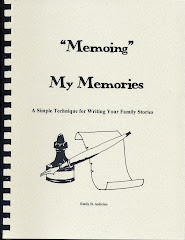
Many of you may know that I administrate a writing group on Yahoo. Recently, one of its members sent me an article from the Wall Street Journal (March 11, 2009, page D1) entitled: Life Stories: Children Find Meaning in Old Family Tales by Sue Shellenbarger.
As this article clearly supports my opinion on the value of sharing family stories, with permission from the author, it is reprinted here.
MARCH 11, 2009, 3:36 A.M. ET
Life Stories: Children Find Meaning in Old Family Tales
By Sue Shellenbarger
When C. Stephen Guyer's three children were growing up, he told them stories about how his grandfather, a banker, lost all in the 1930s, but didn't lose sight of what he valued most. In one of the darkest times, Mr. Guyer says, when his grandfather was nearly broke, he loaded his family into the car and took them to see family members in Canada. The message: "There are more important things in life than money," says Mr. Guyer, of Littleton, Colo.
The tale took on new relevance recently, when Mr. Guyer downsized to a small house from a more luxurious one. He was worried that his children, a daughter, 15, and twins, 22, would be upset. To his surprise, they weren't. Instead, their reaction echoed their great-grandfather's. "What they care about," Mr. Guyer says his children told him, "is how warm are the people in the house, how much of their heart is accessible."
As parents cut budgets, many are finding family stories have surprising power to help children through hard times. Storytelling experts say the phenomenon reflects a growing national interest in telling tales, evidenced by a rise in storytelling events and festivals. New research bears out the value of family stories, linking teens' knowledge of them to better behavior and mental health.
An Emory University study of 65 families with children ages 14 to 16 found kids' ability to retell parents' stories was linked to a lower rate of depression and anxiety and less acting-out of frustration or anger, says Robyn Fivush, a psychology professor. Knowing family stories "helps children put their own experience in perspective," Dr. Fivush says.
The trick is telling the stories in a way children can hear. We're not talking here about the kind of story that begins, "When I was a kid, I walked to school every day uphill both ways, barefoot in the snow." Instead, choose a story suited to your child's needs, and make eye contact to create "a personal experience," says Sherry Norfolk, chairman of the National Storytelling Network, a Jonesborough, Tenn., nonprofit. "You don't have to tell children what they should take from the story," she says. "They can intuitively understand what the moral is."
When Carla Freeman's daughter became anxious a few years ago about having to change schools, the Atlanta mother related her own childhood stories of switching to another school in her community. Her old friends dropped her and, at her new school, "I was kind of an oddball" at first, she told her daughter. But Ms. Freeman bounced back and made new friends. She credits the stories with helping her daughter, now 12, develop resiliency and the ability to "hold herself together" against challenges.
A touch of humor helps. At Scott Prengle's Dallas home, his son Bobby, 17, has heard tales about his grandfather growing up in times so hard that his hungry schoolmates would devour apple cores left over from his lunch. As Bobby tapped a nearly empty salad-dressing bottle over his salad at dinner one evening, Scott laughed and invited him to do as his grandfather did: Put water in the bottle and shake it up, to use every last drop. Scott says his father's frugal habits "drove us crazy, but the idea was that nothing went to waste."
While Bobby declined to water down his dressing, he says of his grandfather that "I follow in his footsteps" in other ways, saving paper clips and rubber bands. And when Scott recently trimmed the family budget, he thought he saw an echo of his late father in Bobby, in the way he calmly accepted the loss of his oft-used gym membership.
Even when you think your children aren't listening to your stories, Dr. Fivush says, they probably are. Thomas Pontes thought his children, 12, 14 and 16, shrugged off tales of his grandfather, an immigrant farmhand who worked his way up from living in a barn to owning a home. To Mr. Pontes, of Providence, R.I., the story shows "the kind of optimism you need to pick yourself up from a field somewhere tending cattle" to cross the Atlantic, fueled solely by hope.
But when I asked his daughter Katie, 16, about the stories, she not only remembered them, but said they've "helped me become more appreciative of my life and how easy things are for me." Even if kids don't seem to appreciate family stories, she says, in time they'll "realize just how important they are."
Ms. Shellenbarger, resident of Portland Oregon area, is the creator and writer of The Wall Street Journal’s “Work & Family” column for which she has received several awards. (See: http://familiesandwork.org/site/events/wlla/site/honorees/2005bios/shellenbarger.html)
Thank you Ms. Shellenbarger.
Emily Aulicino
Portland, Oregon
©29 March 2009
Showing posts with label Memories. Show all posts
Showing posts with label Memories. Show all posts
Sunday, March 29, 2009


Sunday, March 22, 2009
Making History by Kim Pearson
Making History: How to remember, record, interpret, and share the events of your life by Kim Pearson, Primary Sources Books, an imprint of Wyatt-MacKenzie, Issaquah, WA (www.primary-sources.com). ISBN: 978-1-032279-75-7. Copyright 2007. $24.95.
I do not usually review books, but when Kim sent me a copy, when several from my writing classes were interested in it, and as her idea of writing is similar to mine, I decided to mention it in my blog.
Many books have been written on the topic of writing one’s memoir. Formerly, there were the books for grandparents which asked basic questions about their lives, then came the books with the one-line topics. The latest generation of memoir writing books encompasses the reasons for writing, various topics, and suggested leads for those topics. Ms. Pearson’s book falls within the latter.
The book begins with excerpts from her writing class and from her own experiences. Although the book may start out a bit slow for some of us who have been involved in teaching such classes, there are many interesting stories which could give the reader ideas and activate the reader’s memories.
Making History is divided into sections: Why Tell Your Stories?, How to Tell Your Stories, and How Your Stories Fit into History with several chapters for each. She explains why she wrote the book and offers her sources (mostly Web sources) and some suggested reading.
Most of us understand that writing is therapeutic, although many genealogists wish to embellish their research by going beyond the dates and places of their ancestors. Many of us write to record those family stories and childhood memories for the future generations. Ms. Pearson gives ideas on how to deal with too much information as all of us have too little time to write all we really know about our lives and those of our ancestors.
From that point, Ms. Pearson divides her book into various sections (Economics & Politics, The Social Fabric, Wars & the International Scene, Technology & Science, Crime & Disaster, Arts & Entertainment, Lifestyle Activities, and The Weird, Trivial & Hard-to-Classify) and offers a detailed timeline for each period. Timelines start in 1930 and most end in 1989 with a few ending earlier. However, the best part of her book ends each of those chapters with ideas on which people can write. Usually there are about a dozen paragraphs for each chapter like the following.
“Scan the events timelines. What sparks a memory? Is there an event listed that makes you think, ‘oh yea, I remember that’? If so, write about this event. How did you learn about it? Di you talk about it? With whom? Were you inspired to do something because of this event? Did this event change your life in any way? Change your thinking?” (p. 119)
All though the timelines are extensive, they are not, of course, all encompassing. Many of these events were probably overlooked in most of our lives, but one never knows what statement will trigger a memory. You can supplement these timelines by using the Internet, if needed.
I suggest using this book as a workbook; that is, one needs to mark it up, underlining and starring important topics and ideas as the book is read. Use post-it notes so you can return to relevant topics and suggestions.
I am pleased to see this quality of book for writing one’s memories, especially as I have used similar techniques in teaching students and know them to work. I have applied the same method of including detailed prompts in my own publication (See the icon on this blog at the right.) and would encourage any of you not to purchase any book on writing prompts unless there is more detail for each topic than just a line or two.
Emily Aulicino
© Mar 2009
Sunday, February 22, 2009
Memories from a Photo
“Memoing” My Memories Topic 21:
Memories from a Photo
If you have not worked on your Timeline lately or cannot recall what else to add, try going through your old photos and jotting down events that happened around them. Hopefully, you have already written the names, locations, and dates on EVERY one of them! Your descendants would greatly appreciate that. If you are like me, you may do it in spurts! It took two broken ankles to get many of them done! I am not hoping to finish the job in the same way, however!
Often looking at the old photos, sharing them with your family, children or grandchildren, you start to recall why that photo was taken, the details of that trip, the wonderful times with those friends….
Choose a photo from your life or one of a family member and write about the circumstances around that photo; your thoughts and memories at that time. Take the time to reflect on how life was then, and possibly how it has changed. What were the people in the photo like; what are your fondest memories of them…?
Remember to include your photo with your computer or paper files.
Reminder: What other photos could you use to help add to your Timeline or stories?
Suggestion: This and the previous ideas are from my booklet "Memoing" My Memories which contains 130 similar prompts on a huge variety of subjects. This booklet is worth the value as it contains many ideas within each prompt. The sprial bound booklet is available by emailing me at: aulicino@hevanet.com
Tuesday, February 17, 2009
The Neighborhood
Below is another excerpt from my booklet. As you can see, those I am posting here are not in order listed in the booklet, but are some random topics to give you the range of ideas and approaches to writing your childhood memories and family stories. This particular topic developed from a teaching strategy and was written in 2003. It is a wonderful subject for many, many stories, and some of my writing students have used it as an underlying theme for their entire memoirs. Even if you lived in several neighborhoods, this can section your life in to various units and allow you to write many memories within the time span, giving the reader an entire picture of your life.
"Memoing" My Memories Topic 8:
The Neighborhood
As we have discussed your childhood home/homes in Topic 4, let us focus on the neighborhood in general and the activities and the events surrounding it. No doubt this could result in countless stories, so we’ll start with a great brainstorming technique to give you the bases for future writings, as well.
If you lived in more than one home, pick one for now, but try this with all of them, if you can. A neighborhood could just be the block on which you lived or the few houses surrounding your rural home.
First, think back to what your neighborhood was like. Was it rural, urban, or suburban? Did you live in a large or small town, in the middle of the city or on the perimeter?
Who were the neighbors? Can you remember their names? Which houses were theirs?
Was there a unique member of your neighborhood...a kind person who asked you to do errands and tipped you enough for a candy bar or ice cream...a grouchy person whose yard often harbored your baseball or balsa wood airplane...the person whom no one knew well…? Was there a bully on the block? (Even if it was YOU!)
What games did you play in the street or yards with neighbor kids? What games differed from the summer through the winter? Where did you play—a vacant lot, the end of the street, a particular yard? Did everyone get along?
After thinking about these things, draw a map of your childhood street. Add some features unique to each house and the names of the people in the houses. Now choose an event centered on this area and write. Be certain to jot down other ideas on which to write later. There is no doubt many great stories to tell….
©Aulicino, Sept 2003
Sunday, February 1, 2009
Take Time to Read Your Story Aloud
Edit Is a Four Letter Word, con't
The letter T is for:
Take time to read your story aloud
Reading your story aloud helps your writing flow with ease. When we write the words come silently from our brain. Often what we think we are writing and the clarity of it is not what our hand is doing. Our thoughts mask our actions. When we reread a story we have writing soon after it was composed, we often read what we intended to write. To us it may sound smooth, sensible, and clear. This is not always the case, and for this reason, we must read aloud and have others read our work aloud.
It is important to wait a few days or so after you have written your story to read it aloud, however. Waiting will help you find where your writing lacks smoothness and clarity. The same is true if you read it aloud at the various stages of editing. Your voice overrides what your brain intended to write, allowing you to read exactly what you did write.
Have others read your story as well. If you or another person stumbles in the reading, examine the sentence for clarity and flow.
Once you have decided that you are done, put the story aside for a few more days. Then return to it to see if it sounds as good as you had previously thought. Your readers and those great-great-grandchildren will appreciate your clarity.
Summary:
There you have it: EDIT is a four letter word…one we can learn to love.
Educate yourself on grammar and punctuation rules.
Draft as many versions as needed for clarity.
Incorporate word and sentence variety.
Take time to read your story aloud.
Mary P., a student in my writing class once stated: We write for ourselves; we edit for others. This is so very true, and, as the purpose of writing is for others to read it, we must sharpen our editing skills.
Once you use these techniques I’ve outlined from Theodore Cheney’s book Getting the Words Right and those I have developed through my teaching, you will greatly improve not only your editing skills, but your writing, as well. When you edit with such focus that these methods require, you will begin to see your own personal writing style. A writing style evolves. Removing the excess and striving for clarity in your work, will allow you to recognize your style.
Writing Style will be a future topic.
Remember: Although editing is a difficult and lengthy task, you will develop skills that will improve your writing in the initial stages so editing will become easier. There is much detail here, so take one step at a time. Your readers will love you for the improvements, and you will be proud of your work.
©Aulicino 5 Dec 2008
Wednesday, December 31, 2008
Draft as Many Versions as Needed for Clarity, Part 2
Edit Is a Four Letter Word, con't
The letter D is for:
Draft as many versions as needed for clarity
Part 2: Edit by Rearranging
Unity
Often a story must be rearranged in order to create a harmony, a unity within itself. Everything aspect must blend and every area must not go beyond the intended focus. This step in revising your draft looks at the unity of individual aspects of writing. Before you begin, you need to review the purpose and direction of your writing. What is your goal for this piece? What is the focus? What message are you trying to convey?
The following areas must agree; they must be consistent throughout your writing.
1. Subject matter – Did you stay on subject or go beyond it?
2. Scope – Have you omitted some areas of your topic or have you stayed within the guidelines of your focus? Working from an outline could help keep you organized.
3. Tone – Does your story have a mood, an attitude which is consistent throughout the piece? Can the reader determine easily that your story is serious, sad, humorous, etc.?
4. Style – Does your style shine? Does the style of writing remain the same voice to the end?
5. Point of View – Did you switch point of view?
6. Characterization – Did you develop believable characters with realistic actions?
7. Scene – Do you move your reader through various scenes with ease? Do your characters interact with the scenery as needed, and is that scenery developed?
8. Tense – Are the verbs in the same tense or if there’s a reason to have different tenses, have you kept them in proper sequence. That is, if a subordinate action happens before the main action, the subordinate action must be in the past tense.
9. Sentences and Paragraphs – Does each sentence deal with similar ideas? If the ideas are distinctively different the sentences are not unified. For a unified paragraph the sentences must be related to the paragraph’s topic and be in a coherent sequence.
Coherence
A coherent story is a combination of logic and form and deals with putting the various elements of your writing in good order. This includes the sequencing of words into sentences, sentences into paragraphs, paragraphs into chapters, etc.
The major methods for organizing are chronological, spatial, and from general to specific. In using chronological sequencing, decide whether your story is best told from past to the present, present to future, or present backward to the past? Or should you start in the middle, then go back and then forward? Descriptive passages are usually best suited for spatial logic. The author should move the reader’s eye in a logical sequence such as from left to right, up to down, etc. when describing a scene. When using general to specific organization or vice-versa maintain this order throughout the story. Choose the method that best fits your story and maintain its unity throughout.
All references need to be unambiguous for the writing to be coherent. You must not lose the reader through confusion. Be careful of sentences that begin with pronouns. Does the previous sentence clarify to whom or what the pronoun refers? Refrain from using multiple pronouns in a sentence as the reader may become confused as to who did what.
Be certain that phrases are in their correct places. Check any sentence with multiple pieces by moving the phrases around to make the meaning clear.
Original:
The keypunch operator incorrectly punched in a program, which created a power failure in the building where she worked for two days.
Revised:
…which created a power failure for two days in the building where she worked.2.
Smooth transitions between ideas in sentences as well as between paragraphs are important for clear understanding. When there are several ideas are of equal importance, the sentence needs a parallel structure.
Original:
She had never gone to a part alone, much less an event like this.
Revised:
She had never gone alone to a party much less to an event like this.
Original:
Readers appreciate your getting to the heart of a matter in a hurry, rather than being forced to red through paragraphs or pages to find it.
Revised:
Readers appreciate your getting to the heart of a matter in a hurry, rather than forcing them to read though…
Original:
We can attack at night or we can do it in the light.
Revised:
We can attack by night or by day.3.
When ideas are not of equal importance, the ideas must not be placed in a parallel form. Some ideas are subordinate to others, and the sentence must clearly indicate that for the reader. For these types of sentences it is best to use one of three logical orders.
1. Time – Lay out the events in the order they occurred.
2. Relationship – Show cause and effect as needed. Time order often reflects the relationship between events.
In the following example, the order of time is used. However, this sentence also shows the order of relationship…a cause and effect.
After the storm abated, I went below. Because the porthole had opened during the storm, damage to the crew’s quarters was severe.4.
3. Emphasis – Place the most important event first to emphasize its significance.
After the storm, I went down below. The crew’s quarters were severely damaged—the porthole had opened during the storm. This, after I had just conducted a storm rill in which Howard had been permanently assigned to dog down that particular porthole.
The above example does place the focus on the open porthole rather than on the storm. For this reason, the author must be wise in selecting the type of order that best fits the focus of the writing.
Smooth transitions
One of the easiest ways to have smooth transitions between sentences is to repeat a key word or a key thought from the previous sentence. Sometimes you may wish to use a synonym, but sometimes the same word works best.
Although there are some trite phrases commonly used for transitions between paragraphs, the same technique of repeating a word or phrase used with sentences can be used with paragraphs. Often the key word, phrase, or idea in the final sentence may be repeated or restructured to use in the first sentence of the next paragraph.
Another type of transition is the one between scenes. Often the author can move the reader from one scene to another with a few simple words.
Example:
Marge sat in the den at the computer, busily typing as the wind howled. Soon creaking sounds began to intensify. She ran to the windows to see what tree was soon to be history.
Next door, the McGill’s peered from their window, gasping in unison as a huge branch from the elm just missed their house.
As you can see the words next door moved the scene from one location to the next with ease.
Another method is to leave extra line of space between paragraphs indicating that extra time has passed and, therefore, a change of scene.
In some cases, the author may choose to use the last sentence of a paragraph to change the scene rather than the first sentence of the next paragraph. Sometimes, the author may only hint at a change of scene in the last sentence. This would be done to continue the rising flow of excitement.
Example:
Bent over the desk for hours, I had managed to block out the sound of the furnace starting and stopping and the creaks of the old house while trying to focus on my writing. I was under a deadline, and the pressure was mounting when…brrr-inggg! Dang, the phone!
I raced to the living room to quiet the monster, tripping on the kids' toys….
The phone ringing indicates an immediate change of scene, whether the phone is in the same room or another.
All parts of the story must be coherent, including the beginning, middle and end. Check your story to see if it flows well between these major elements. The plot is usually hinted at in the beginning and then is developed in the middle. Here the conflict becomes apparent to the point of crisis. The ending provides the resolution of the conflict and ties up any loose ends.
Remember: Although editing is a difficult and lengthy task, you will develop skills that will improve your writing in the initial stages so editing will become easier. There is much detail here, so take one step at a time. Your readers will love you for the improvements, and you will be proud of your work.
Next, the letter D (part 3 of 3) in that four letter word Edit.
D stands for: Draft as many versions as needed for clarity.
Part 3 covers Edit by Rewording
Source (adapted from):
Cheney, Theodore A. Rees. Getting the Words Right: How to Revice, Edit & Rewrite, Writer’s Digest Books, Cincinnati, OH, 1987.
2. Cheney, p. 59.
3. ibid., p. 64-66.
4. ibid., p. 69.
©Aulicino 5 Dec 2008
Wednesday, October 29, 2008
All Memories Past and Present
Most of us are interested in writing about our childhood memories and family stories, bringing the past to the present. Most of those reading this are genealogists, after all.
We have been taught not to forget the past as remembering and understanding our history will help us not to repeat the parts we wish to ignore. It is very important to record what our ancestors did, how they lived, and what they thought. It is equally important, however, to record the present…that fleeting present that so quickly becomes the past.
Not only would your great-great-grandchildren wish to know what life is like now, but they would want to know more about the person who is preserving their family heritage…YOU. It is only fair that they understand you, your interests, and what your life is like currently.
It is often difficult to write about ourselves and about the present. We believe that the Internet will preserve every thought, every artifact, and every move our society makes. We often believe that our presence is of lesser importance than our past. To you that may be so, but you are not writing your memories for you, but for your descendants…and not just your children or grandchildren. You must consider a larger view and understand that your work will be passed along for many generations. Those who read about you and your family stories may not understand the terms we use today, or the specifics of our society. For these reasons, you must record the present while preserving the past.
And just how does one do that?
Many of you may already record snippets of the present and do not realize it. Those who keep a date book, write on a calendar, write letters or emails are recording the present. Gather all these into one place. That place could be a timeline which I have discussed in previous articles. Your Timeline can be used for your childhood memories, as well as a diary for more current activities. Using a computer and disciplining yourself to jot down the events of the week on a certain schedule will greatly help.
However, there are some very important topics that should be larger stories. Most of these are covered in more detail in my booklet, but for the one-line version of a few ideas, you could include writing about:
1. How and why you were given your name.
2. Your personality. (Just what do you know and understand about yourself?)
3. The role various organizations play in your life. (clubs, religion, social groups, etc.)
4. The people who have influenced your life.
5. The lessons you have learned within your life.
6. Your typical day or week.
Lastly, there are the events in society today. These are very important to record as headlines are being made daily. The following are just a few topics of great significance in recent times.
1. Where were you on 9/11, and how did if affect you and our society?
2. Rising gas prices over the last few years with a bit of relief in the present.
3. The wars in Afghanistan and Iraq.
4. Our unique political race for President. (We will make history no matter the outcome.)
5. The financial turmoil we are experiencing.
6. The growth and direction of technology.
When you are writing about those ancestors or about your childhood, remember that you will be an ancestor to others, and they will wish to know more about you as an adult. You and the present climate are just as important as your past family members!
©aulicino, 29 Oct 2008
Sunday, October 26, 2008
Writing Prompts: The Good, The Bad, The Ugly
Writing prompts, like most things in life, come in a variety of packages. Basically, there are three types: The Good, The Bad, and The Ugly. Rather than tell you about these different styles of prompts, the following is written as an experiment to show you how well each works.
To take those three types of prompts in reverse, I’ll start with…
The Ugly
Most of us do not consider all the previous topics I have posted on this blog when we begin to write our family stories and childhood memories. Frankly, knowing about Getting Started, Timelines, Writer’s Block, Organizing Your Stories, Revising, Point of View, etc. is not necessary for you to write a wonderful selection of stories for your descendants. You only need to begin with any memory that your recall.
SO…let’s begin with that memory….
Well? Have you written on that memory? Could you think of a memory or are you still deciding upon which one to write? Was that ugly or what? Imagine doing that for all your childhood stories. How quickly would you get discouraged?
The Bad
Ok, now, let’s try this experiment. For the remainder of this article, do each step as you read it. Do not look ahead as you will only cheat yourself. Try this little test, and allow me show you the differences between writing prompts and how they affect your stories.
First, take a couple sheets of paper, your favorite writing tool, and a clock or timer.
Next, set your timer for two minutes or watch a clock, if possible, while you write.
Write any and everything that comes to mind for the next two minutes on the prompt below. Write down whatever you are thinking, even if it is not on-topic. You may have to write that you cannot think of anything.
PROMPT: Write about a time when you were a child in your neighborhood.
Stop when you reach two minutes.
Were you able to choose a story quickly or did you spend much of the time thinking? How much did you write?
The Good
Read the following prompt and do the suggested drawing. Then proceed to write your story. After you have written, answer the questions below the prompt.
“Memoing” My Memories Topic 8: The Neighborhood
It is time to focus on your neighborhood as a child and the activities and the events surrounding it. No doubt this could result in countless stories, so we will start with a great brainstorming technique to give you the bases for future writings, as well.
If you lived in more than one home, pick one for now, but try this with all of them, if you can. A neighborhood could just be the block on which you lived or the few houses surrounding your rural home.
First, think back to what your neighborhood was like. Was it rural, urban, or suburban? Did you live in a large or small town, in the middle of the city or on the perimeter?
Who were the neighbors? Can you remember their names? Which houses were theirs?
Was there a unique member of your neighborhood...a kind person who asked you to do errands and tipped you enough for a candy bar or ice cream...a grouchy person whose yard often harbored your baseball or balsa wood airplane...the person whom no one knew well…? Was there a bully on the block? (Even if it was YOU!)
What games did you play in the street or yards with neighbor kids? What games differed from the summer through the winter? Where did you play—a vacant lot, the end of the street, a particular yard? Did everyone get along?
After thinking about these things, draw a map of your childhood street. Add some features unique to each house and the names of the people in the houses. Now choose an event centered on this area and write. Be certain to jot down other ideas on which to write later. There is no doubt many great stories to tell….
©Aulicino, 2003
Questions:
1. For the last exercise were you able to start writing within two minutes of completing your neighborhood map?
2. Which prompt produced the most ideas for writing?
3. By drawing the map of your neighborhood did you recall more events than with the first prompt?
4. Was it more difficult to write a story with the second prompt as you may have had many ideas?
5. Which method do you feel would be more beneficial to you in writing your childhood stories for your descendants?
Summary
The ugly business of trying to write your memories as they pop into your head is quite difficult given the busy lives we conduct. Perhaps memories might be triggered by events in our daily activities, but by the time we sit down to write, they may be gone. Often, by waiting until story ideas occur to us, we are apt to tend to other needs in life.
There are many, many bad prompts in books and on the internet. Many of us have received books from our children or grandchildren with these types of prompts and a lined page on which to write. Few people start these books and even fewer complete them. This type of one-line prompt can be useful, but lacks enough stimuli to assist people in writing quickly. You waste precious time “thinking” about a prompt when you could be writing.
The good prompts are those which do not waste your time, which provide suggestions to stimulate your memory, and which give you more than one idea for a story. This often cannot be done with one-sentence prompts.
The above prompt, The Neighborhood, is from my booklet “Memoing” My Memories which is available for sale. This booklet has 130 prompts using this detailed style to assist you in recalling your family stories and childhood memories. Although there are only 130 prompts, they are written to provide you with many more story ideas for each topic. The booklet also contains organizational tips, information on how to write a timeline when you do not have time to write longer stories, ideas for improving verbs and sentence structure, and some general writing tips. The booklet is spiral bound with a heavy cardstock cover and 70 pound Vellum pages.
Contact me directly at aulicino@hevanet.com to purchase this booklet.
©aulicino, 26 Oct 2008
Subscribe to:
Posts (Atom)


 Posts